

Here is the math nobody tells you about hosting.
You spend three hours on the food. You spend forty-five minutes on the table. And then you spend the entire next morning washing sixteen pieces of linen that have cranberry sauce on them.
The table is the part everyone photographs. It is also the part that punishes you the hardest the day after.
So let's talk about the paper table.
The paper table is not a compromise
I know what "paper placemat" sounds like. It sounds like a diner. It sounds like something you put under a toddler.
It is not that.
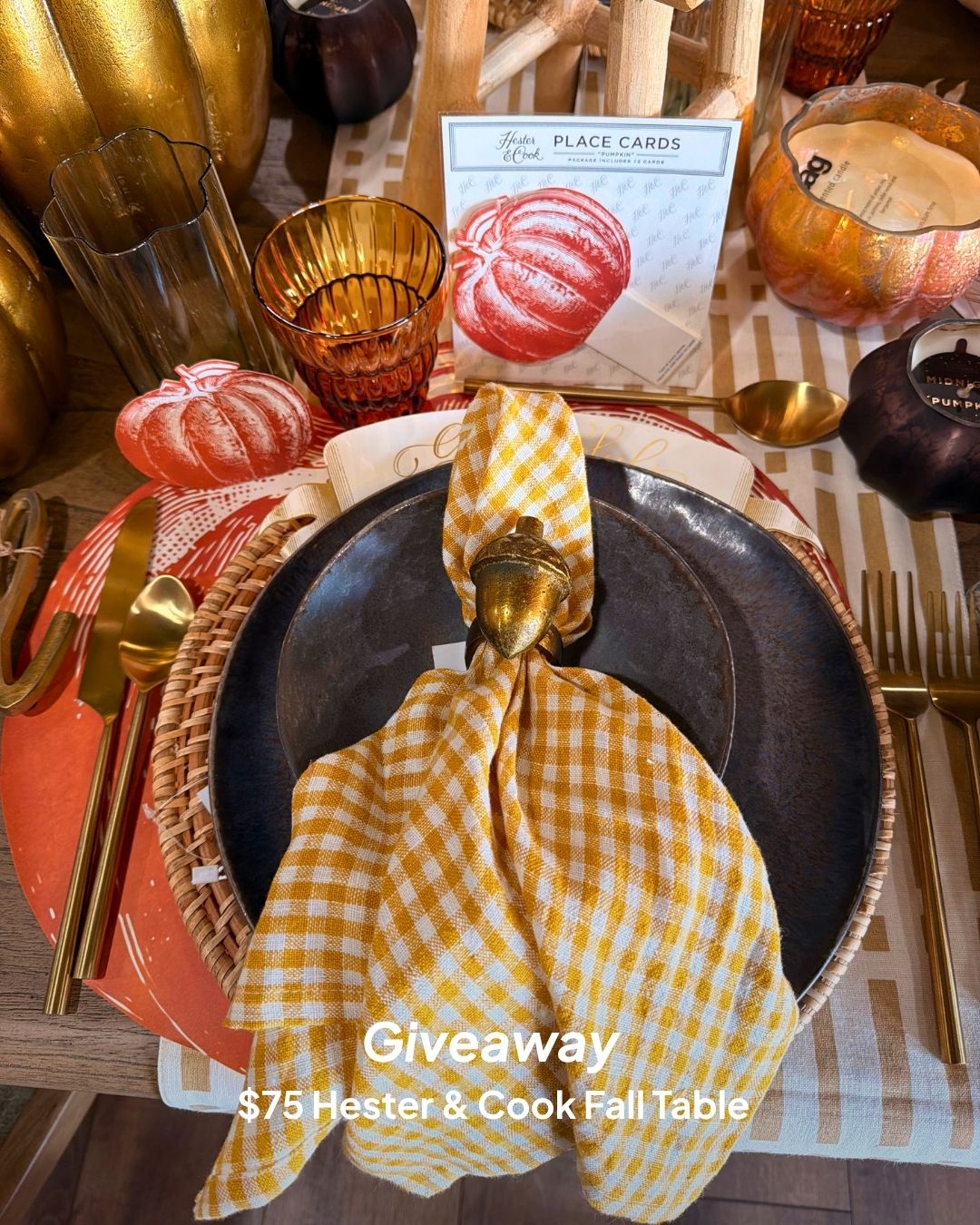
A good paper table setting is printed, thick, and detailed enough that guests pick it up to look at the artwork. Hester & Cook built their whole business on this idea, and they were right. The pumpkin placemat we have in store right now is a woodcut illustration, printed in a deep rust, on paper heavy enough that it lies flat without curling at the corners.
Nobody at your table is going to think "ah, paper." They are going to think "where did she get these."
And when dinner is over, you roll them up and throw them away. That's it. That's the whole pitch.
Start with the placemat, not the centerpiece
Most people build a table from the middle out. Centerpiece first, then everything gets arranged around it, and by the time they get to the place settings they've run out of ideas and energy.
Flip it.
The placemat is the thing directly in front of each person for two hours. It's the part they actually look at. Get that right and the center of the table can be three pumpkins and a candle and it will still read as intentional.
If you want to layer, put a runner underneath and let the placemat sit on top at a slight angle. That tiny bit of asymmetry is what keeps a table from looking like a hotel banquet.
The three-layer rule
Every table setting I actually like has three layers, and no more than three.
One: the base. The runner, or the bare wood if you're brave.
Two: the placemat. This is your color and your pattern. Everything else takes its cue from here.
Three: the plate, and whatever you tuck under or beside it.
That's where a charger, a woven underplate, or a dark stoneware plate does real work. Warm rust paper under a matte black plate is one of my favorite combinations in the store right now, because the contrast does all the styling for you.
Stop at three. A fourth layer is when a table starts to feel like it's trying.
A note on mixing patterns
You can absolutely put a striped napkin on a pumpkin placemat. The rule is scale, not color: if one pattern is large, the other should be small. The Burleigh Stripe napkins work with the pumpkin placemat because the stripe is fine and dense and the pumpkin is one big graphic shape.
Two large patterns fight. One large and one small talk to each other.
Place cards are not fussy
I will die on this hill.
People think place cards are formal. They're not formal, they're kind. They tell your guests where to sit so nobody has to do that awkward hover behind a chair waiting for permission.
They also let you do the thing every good host does quietly: seat people next to someone they'll enjoy. Your cousin who talks a lot goes next to your friend who likes to listen. The two people who both just got back from Italy go together. That's not fussiness. That's the whole job.
Die-cut pumpkin place cards do this without anybody feeling like they wandered into a wedding.
Napkins are where you cheat
Here's the sleight of hand. Guest napkins, the paper kind, in a pattern good enough to feel like cloth.
Fold one in thirds and lay it across the plate. Or tuck it under the fork. Or run it through a napkin ring if you have one, which instantly makes paper read as linen.
The Burleigh Stripe guest napkins are the ones I keep restocking at home, because the print is dense enough that from two feet away nobody can tell. And you are not ironing anything on Thursday night.
What actually goes in the middle
Since we flipped the order, the centerpiece is last, and it should be low.
Low. I mean it. If your guests can't see the person across from them, the arrangement is decoration for you and an obstacle for everyone else.
Candles at eye level or below. A row of small pumpkins straight down the middle. A single branch laid flat. Table accents that stand up on their own, like the Grateful gold accents, give you height without building a wall.
Fall is the easiest season for this because the season does the work. Anything you pick up outside on a walk is already the right color.
So we're giving one away
We styled a full fall table in store this week and then decided we wanted to send one home with somebody.
The set is Hester & Cook from top to bottom, a $75 value: the pumpkin paper placemats, the Grateful gold table accents, the die-cut pumpkin place cards, and the pumpkin Burleigh Stripe guest napkins. Everything in this post, essentially, minus the plates.
To enter, go to the post below and tag your hostess or the guests you'd seat at this table. Each comment is an entry, so tag as many people as come to mind. Entries close at midnight Friday, October 9, and we'll tag the winner in stories on Saturday, October 10.
You need to be following @ivoryandoliveshop to win, be 18+, and have a US shipping address. And no, Instagram has nothing to do with it.
If you'd rather not wait
The whole fall tabletop collection is in store and online right now, and the pieces in this post are all under $20 each. Which means you can build the entire table for less than the cost of one nice candle.
Come see it set up in person if you're local. It's easier to picture on your own table once you've seen it on ours, and we will absolutely help you pick a napkin.
📍 24847 Del Prado, Dana Point, CA 92629
Tuesday through Friday 11 to 6, Saturday 11 to 5
Now go tag your hostess.
xoxo, Katie + Shana


